Personal Finance for People With Variable Income: A Practical System That Actually Works
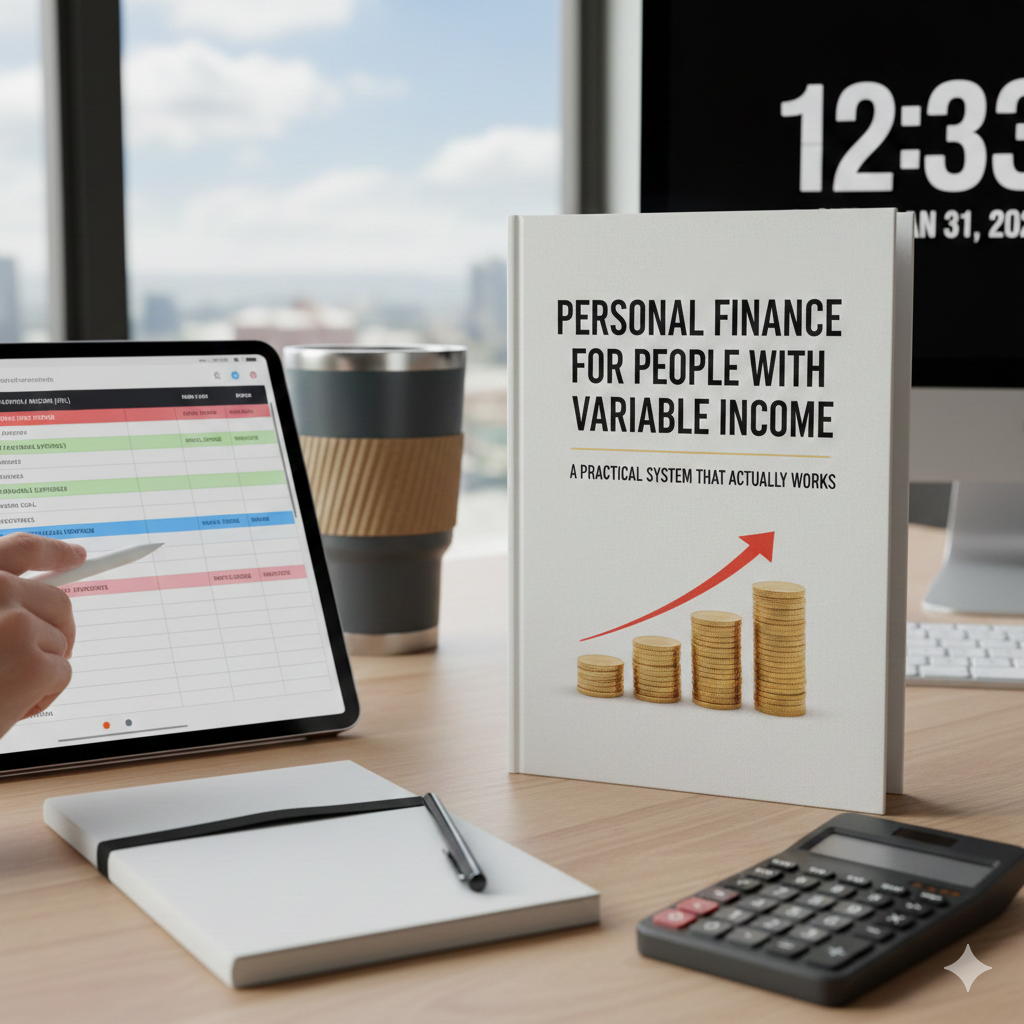
Managing personal finances is already challenging. Managing them when your income changes every month is on another level. Freelancers, creators, commission-based workers, entrepreneurs, salespeople, gig workers, and seasonal employees all face the same core problem: uncertainty.
Most financial advice assumes a stable paycheck. When that assumption doesn’t hold, traditional budgeting methods fall apart, leading to stress, overspending in good months, panic in bad ones, and a constant feeling of being behind.
This guide focuses on systems, not motivation. The goal is to help you stabilize your finances even when your income is unpredictable—without relying on unrealistic discipline or perfect months.
Build Your Financial Life Around Your Lowest Income Month
The most important rule when income is variable is simple but uncomfortable:
Your lifestyle must be affordable in your worst months, not your best ones.
Most people do the opposite. They experience a high-income month, mentally upgrade their lifestyle, and assume future months will “work out.” When income drops, they rely on credit cards, savings, or stress.
How to define your baseline income
- Look at your last 6–12 months of income.
- Identify the lowest earning month (or the average of the lowest 2–3).
- Treat that number as your financial baseline.
This baseline becomes the income you use to:
- Cover fixed expenses
- Set your minimum savings
- Define what you can safely spend
Any income above that baseline is not spending money by default. It is stability money.
Separate Survival Money From Growth Money
People with variable income need clear boundaries between money that keeps life running and money that improves it.
Use multiple accounts (or digital equivalents)
| Category | Details |
|---|---|
| Separate Your Money into Accounts | At minimum, separating money into distinct accounts creates clarity and prevents a false sense of abundance. |
| Operating Account: | – Rent- Utilities- Food- Transportation- Insurance- Minimum debt payments |
| Stability Account: | – Emergency fund- Income smoothing buffer- Covers shortfalls in low-income months |
| Growth Account: | – Investments- Business reinvestment- Optional upgrades- Long-term goals |
| Key Insight | When all money sits in one place, it can create a false sense of abundance. Separation creates clarity. |
Create an Income Smoothing System
Income smoothing is the single biggest upgrade you can make if your earnings fluctuate.
What income smoothing means
Instead of living directly off whatever you earn this month, you:
- Save excess income in high months
- Use that buffer to supplement low months
- Pay yourself a consistent “salary” from your own money
How to implement it step by step
| Create a Monthly “Salary” from Variable Income | Decide on a fixed monthly “salary” based on your baseline income to create predictability. |
| In High-Income Months | – Pay yourself that salary – Move the excess into your stability account |
| In Low-Income Months | – Pay yourself the same salary – Cover the gap using your buffer |
Prioritize a Larger Emergency Fund Than Average
Standard advice suggests 3–6 months of expenses. For variable income, that is often not enough.
A safer target
- 6–12 months of essential expenses
- Focus only on necessities, not lifestyle spending
This fund is not an investment. It is insurance against:
- Dry spells
- Late payments from clients
- Market downturns
- Health issues
- Burnout
The psychological benefit alone is worth the effort. When you know you can survive a bad year, you stop making desperate decisions.
Budget With Percentages, Not Fixed Numbers
Traditional budgets fail with variable income because they rely on fixed amounts. A better approach is percentage-based
| Flexible Budgeting Framework | An example framework for managing income effectively, especially when variable. |
| Allocation Example | – 50–60% Essentials – 10–20% Savings and buffer building – 10–20% Investments or debt reduction – 10–20% Discretionary spending |
| Priority Order | – Survival – Stability – Future – Lifestyle |
Automate Decisions to Reduce Emotional Spending
Variable income creates emotional swings:
- Confidence and optimism in good months
- Fear and scarcity in bad ones
Automation removes emotion from the equation.
What to automate
- Automatic transfers to:
- Emergency fund
- Stability buffer
- Investment accounts
- Automatic bill payments
- Automatic “salary” transfers to yourself
The less you decide manually, the less likely you are to sabotage your system.
Treat Irregular Income Like a Business, Not a Paycheck
People with variable income often act like employees emotionally but are functionally businesses financially.
Adopt a business mindset
- Your income is revenue, not salary
- Taxes, savings, and downtime must be planned
- Not all money earned is yours to spend
This mindset shift alone prevents many common mistakes, especially overspending during strong months.
Plan for Taxes Before You Feel Rich
Taxes are one of the biggest sources of financial shock for people with variable income.
Practical approach
- Set aside a percentage of every payment immediately
- Keep tax money in a separate account
- Never use it for living expenses
This avoids the cycle of:
“I’ll figure it out later” → panic → debt
Adjust Your Lifestyle Gradually, Not Reactively
Lifestyle inflation is especially dangerous with variable income.
A safer rule
Only upgrade your lifestyle after:
- At least 12 months of consistently higher income
- A fully funded emergency and smoothing buffer
- No reliance on credit to cover essentials
Temporary income spikes should improve your financial foundation, not your fixed expenses.

Use Financial Reviews Instead of Daily Tracking
Daily expense tracking is exhausting and often unsustainable.
Better alternative
- Monthly financial review
- Quarterly system adjustment
- Annual lifestyle evaluation
Focus on trends, not perfection. Stability comes from systems, not micromanagement.
Protect Your Mental Health Around Money
| Strategies | Solutions |
|---|---|
| Psychological Impact of Unstable Income | Unstable income doesn’t just affect your bank account—it impacts decisions, confidence, and long-term planning. |
| Strategies That Help: | – Define “enough” clearly – Avoid comparing yourself to salaried earners – Build buffers to buy peace of mind, not just returns – Accept variability as normal, not failure |
| Key Insight | Financial stability is as much psychological as it is mathematical. |
Long-Term Investing With Variable Income
You can still invest consistently with fluctuating earnings.
How to do it safely
- Invest from surplus only
- Use dollar-cost averaging when possible
- Prioritize liquidity before aggressive growth
- Avoid locking money you may need soon
Consistency over time matters more than perfect timing.
Common Mistakes to Avoid
- Spending based on peak months
- Treating savings as optional
- Mixing tax money with personal money
- Using credit to smooth income instead of savings
- Ignoring low-income months when planning
Avoiding these mistakes often matters more than finding the “perfect” strategy.
Conclusion
Variable income is not the problem. Lack of systems is.
When you build your financial life around:
- Conservative assumptions
- Strong buffers
- Clear separation of money
- Automation and structure
Your income stops controlling your stress levels.
The goal is not to eliminate uncertainty—but to become resilient to it.
Frequently Asked Questions (FAQs)
How much should I save if my income changes every month?
Start with a goal of 6–12 months of essential expenses. Beyond that, save a percentage of every payment rather than a fixed amount.
Is budgeting even realistic with variable income?
Yes, but it must be flexible and percentage-based, not rigid. Focus on priorities, not exact numbers.
Should I pay off debt or build an emergency fund first?
For variable income, build at least a basic emergency fund first, then tackle high-interest debt. Stability comes before optimization.
How do I avoid overspending in good months?
Separate accounts and automate transfers. If excess income never sits in your spending account, it’s harder to misuse.
Can I invest if my income is unpredictable?
Yes—invest only from surplus, keep adequate liquidity, and avoid investments that lock up money you may need during low-income periods.


Very good article