How to Stop Living Paycheck to Paycheck and Start Investing with Little Money

Living paycheck to paycheck isn’t just a financial condition — it’s a psychological state.
It’s waking up already calculating. It’s checking your bank balance before buying groceries. It’s feeling a wave of anxiety every time your phone buzzes with a payment notification. Even if you’re earning a “decent” salary, the constant reset to zero creates stress that compounds over time.
What makes it worse is the illusion that the solution is always “more income.” And while income matters, it’s rarely the first lever you should pull.
For a long time, I believed that once I earned more, everything would change. I imagined a future where investing felt easy because I’d finally have “extra” money. But when my income increased, so did my expenses. Better apartment. Better phone. More eating out. The cycle didn’t disappear — it upgraded.
The real escape came when I stopped focusing on income alone and started focusing on financial structure.
If you’re tired of surviving month to month and want to start building wealth — even with limited money — this is your practical roadmap.
Understanding the Paycheck-to-Paycheck Trap
The paycheck cycle survives on three powerful forces:
- Habit
- Urgency
- Lack of margin
When money comes in and immediately flows out, you never build separation between earning and spending. There’s no buffer. No breathing room. No strategic pause.
And without pause, there’s no investing.
It’s important to understand this: the paycheck-to-paycheck cycle is not a moral failure. It’s a structural issue.
Most people were never taught:
- How to allocate money intentionally
- How to build financial buffers
- How to automate savings
- How investing actually works
Without systems, spending becomes reactive. And reactive finances always feel fragile.
The goal isn’t just to “save more.”
The goal is to create margin.
Margin creates options. Options create freedom.
Step 1: Create Immediate Financial Breathing Room
Before you invest, you need stability.
Not perfection. Not a six-month emergency fund. Just a starting cushion that prevents small emergencies from becoming financial disasters.
Aim for $500 to $1,000 first.
This may feel small. But psychologically, it changes everything.
Without an emergency fund:
- A flat tire becomes a credit card balance.
- A medical bill becomes months of stress.
- A broken appliance becomes new debt.
With even a small buffer, problems stay contained.
Here’s how you can realistically build it:
| Action | Why It Works | Estimated Result |
|---|---|---|
| Cancel 1–2 unused subscriptions | Immediate expense cut | $20–$100/month |
| Sell unused items | Converts clutter to cash | $100–$500 |
| Short-term gig work | Temporary income spike | $200–$800 |
| Redirect bonuses/refunds | Lump sum boost | Fast progress |
The key is intensity over duration. A focused 30–45 day push can create the foundation you need.
And once you feel that first sense of financial stability, motivation increases.
Step 2: Track Spending with Radical Awareness
Most people underestimate how much money leaks through unnoticed habits.
Small purchases feel harmless:
- $8 delivery fees
- $15 streaming subscriptions
- $5 coffee runs
- Impulse online shopping
Individually, they seem insignificant. Collectively, they erode your margin.
For one full month, track everything.
Not casually. Not approximately.
Every dollar.
This exercise isn’t about guilt. It’s about clarity.
You may discover:
- 10–20% of your income is flexible
- Recurring charges you forgot about
- Emotional spending patterns
Once you see patterns, you regain control.
A simple budgeting framework can help:
| Category | Percentage | Purpose |
|---|---|---|
| Needs | 50% | Housing, utilities, groceries |
| Wants | 30% | Entertainment, dining |
| Savings & Investing | 20% | Emergency fund, investments |
If 20% feels unrealistic, start with 5–10%. Even 5% builds identity.
Because the moment you stop consuming 100% of your income, the cycle begins to weaken.

Step 3: Automate Your Escape
Willpower fades. Automation scales.
The most powerful shift you can make is setting automatic transfers immediately after payday.
Your paycheck should flow like this:
Income → Savings → Investments → Spending
Not the other way around.
Even $25 per week invested automatically builds psychological momentum. It removes the monthly decision. It removes emotional hesitation. It turns investing into a habit instead of a debate.
Automation reduces friction.
And reduced friction increases consistency.
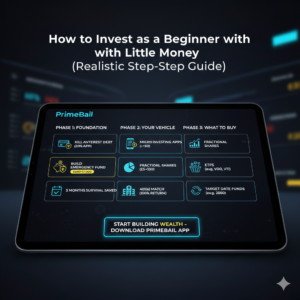
Step 4: How to Start Investing with Little Money
Here’s where most people hesitate.
They believe investing requires thousands of dollars. That’s outdated thinking.
Modern investing platforms allow:
- Fractional shares
- Low minimum index funds
- Commission-free ETFs
You can start with $50. Sometimes less.
Beginner Investment Options
| Investment | Why It’s Beginner-Friendly | Risk Level |
|---|---|---|
| Index Funds | Diversified & low cost | Moderate |
| ETFs | Broad market exposure | Moderate |
| Fractional Shares | Flexible entry point | Varies |
| Retirement Accounts | Tax advantages | Long-term focus |
Index funds deserve special attention.
Instead of trying to pick winning stocks, you invest in the broader market. You spread risk across hundreds of companies. Historically, markets grow over long periods.
It’s not exciting.
It’s not flashy.
But it works.
Step 5: Eliminate High-Interest Debt Strategically
If you’re paying 20–25% interest on credit cards, investing aggressively may not make sense yet.
High-interest debt grows faster than most investments.
You have two primary strategies:
| Strategy | Description | Psychological Impact |
|---|---|---|
| Snowball | Pay smallest balance first | Motivating |
| Avalanche | Pay highest interest first | Financially efficient |
Momentum matters more than mathematical perfection.
Once high-interest debt is eliminated, every dollar invested becomes more powerful.
Step 6: Expand Income Once Structure Exists
Sometimes the numbers truly don’t work.
If after optimizing expenses you still have no margin, increasing income becomes necessary.
But do it strategically.
Focus on:
- Skill stacking
- High-income skills
- Negotiating raises
- Remote freelance work
- Industry shifts
An additional $300–$500 per month invested over 10–15 years creates meaningful compounding.
Income growth accelerates wealth.
Structure sustains it.
The Power of Compounding Over Time
Let’s say you invest $200 monthly with an 8% average return.
After 5 years:
- Contributions: $12,000
- Estimated value: ~$14,700
After 10 years:
- Contributions: $24,000
- Estimated value: ~$36,000+
After 20 years:
- Contributions: $48,000
- Estimated value: ~$118,000+
Time amplifies consistency.
The earlier you start, the less you need to contribute.
The Identity Shift That Changes Everything
Escaping paycheck-to-paycheck isn’t just about numbers.
It’s about identity.
You move from:
- Consumer → Investor
- Reactive → Strategic
- Stressed → Intentional
Instead of asking,
“Can I afford this?”
You begin asking,
“Does this align with my long-term freedom?”
That question changes spending behavior permanently.
And when behavior changes consistently, financial outcomes follow.
Conclusion
Financial freedom doesn’t require a massive income.
It requires:
- Structure
- Discipline
- Automation
- Patience
You don’t escape paycheck-to-paycheck overnight.
But with small, consistent changes, you create margin.
Margin creates stability.
Stability creates opportunity.
And opportunity, compounded over time, creates wealth.
Start small. Stay consistent. Let time do the heavy lifting.
Frequently Asked Questions (FAQs)
1. Can I really start investing with just $50?
Yes. Many brokerages allow fractional shares and low minimum index funds. The key is consistency over time.
2. Should I eliminate all debt before investing?
High-interest debt should be prioritized. Low-interest debt can sometimes coexist with investing strategically.
3. How long does it realistically take to stop living paycheck to paycheck?
With structure and discipline, many people see meaningful improvement within 3–6 months.
4. What’s the safest way to invest as a beginner?
Broad market index funds are widely considered one of the safest long-term strategies due to diversification.
5. What if my income barely covers expenses?
Focus first on:
- Building a small emergency fund
- Reducing flexible spending
- Increasing income gradually
Investing can begin once minimal stability is achieved.
The information provided in this article is for informational and educational purposes only and does not constitute financial, legal, or investment advice. While efforts are made to ensure accuracy, PrimeBail makes no guarantees regarding completeness or applicability to individual circumstances. Readers are encouraged to consult a qualified professional before making any financial decisions.